
“Help your sister carry the suitcases,you are a boy!”
“I will drive you to your workplace,it will be difficult for you to drive in this traffic.”
“Let me pick up those cartons,they are far too heavy for you.”
On observing closely we find that the first half of each sentence reflects courtesy, kindness, and a genuine desire to help. However, the second half subtly shifts the meaning, making the person receiving the help–a woman– appear fragile and incapable. When we look around, the men in our lives– our fathers, brothers, and colleagues often step in to support us in every way they can. Yet, it leaves us wondering, do they offer this help out of genuine care, or because society has conditioned them to believe women are simply too delicate for everyday physical tasks?
This perception feels especially ironic when we look at the other side of life. One of the most physically demanding experiences in the world, childbirth, is endured solely by women. To bring a new life into the world, a woman goes through immense physical agony, often compared to the pain of twenty bones fracturing at once. Despite this, society often treats it as routine.This pain is experienced by women across every region, background, and social class, regardless of wealth or privilege. Even more striking is what comes after this experience. Family and friends welcome the baby happily with great pomp and show but the silent sacrifices of the mother are often unheard and overlooked . She is expected to bounce back quickly and resume her household duties as if everything were solely her responsibility.
Constant comparisons are made about how fast women recover and how quickly their bodies return to how they looked before.
Even setting aside the physical pain, the profound internal changes a woman’s body and mind go through are often beyond the awareness of those around her, sometimes even her own partner. Of course, a father plays a vital and irreplaceable role in raising a child. Still, when we consider the deep physical and emotional burden a mother carries from pregnancy onward, it becomes clear that women possess a quiet, unmatched endurance that deserves true recognition rather than being labelled as the weaker sex.
Creating a life and still being labelled as delicate?
Is feminine energy really too weak?
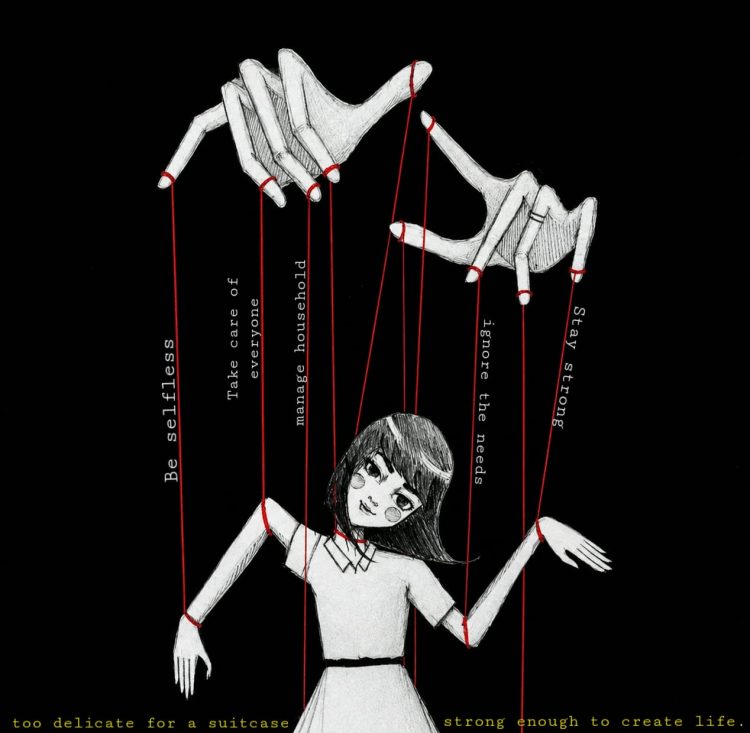
Perhaps it is the need of the hour to start giving our time, empathy, and energy to the women in our homes rather than spending hours worshipping idols of the supreme power. I often wonder what the creator of the universe feels when watching people pray for hours, only to turn around and normalise the silent sacrifice of the very women who bring new life onto this world. Too often, a woman is expected to erase herself in the process, becoming a mother first, a wife second, and a human being last. We have all seen our mothers saving the last piece of cake for us! Was she really not craving that piece herself or had she become so accustomed to sacrifice? Though this instance appears to be trivial, it still forces us to ponder over this deeply.
I have often asked the women around me how they manage to do it all. I expected them to tell me how exhausting it was, how much strength it demanded, or how deeply it changed them. Instead, their answers surprised me. Most of them simply viewed motherhood as their duty. To them, having a child was just an expected milestone of marriage, something done without question, driven by the unspoken fear of what society might say if a woman chose otherwise. It felt as though they rarely paused to think of their own desires or limits. Their primary concern was how their choices would be perceived by others.
Why is she so selfish?
Experiencing motherhood is important and inevitable for every woman!
If she wants to continue with her career then she must know how to strike a balance along with her family responsibilities.
Over generations, this silent endurance has been praised as a virtue, leaving little room for women to simply be human. When strength is only celebrated through sacrifice, women are denied the grace to rest, to complain, or to ask for support without feeling guilty. True respect does not mean shielding women from carrying a suitcase while expecting them to carry the weight of an entire household on their shoulders.
Thankfully, a quiet yet meaningful shift is already underway. Today, women are more aware of their worth, their physical limits, and their right to put themselves first without guilt. At the same time, a growing number of men are unlearning old habits by choosing to listen, share the invisible load of parenting and household responsibilities, and offer help out of true partnership rather than pity.
Conversations around postpartum recovery, mental health, and equal responsibility are no longer whispered behind closed doors,they are becoming a normal part of modern households.
Real change continues to grow when we rethink the way we look at both strength and care. Offering help should always come from love and equality, not from an assumption of weakness. At the same time, recognising a woman’s resilience should never mean taking her pain for granted. Women do not need to be placed on a pedestal as tireless goddesses, nor treated as fragile beings who need rescuing. They simply deserve to be seen, heard, and valued as equals in every quiet struggle and every everyday moment.
