
From the moment a girl picks up lip gloss in one hand and a book in the other, the world starts glitching. Society loves its binaries – you can be pretty or smart, stylish or serious, soft or revolutionary. Apparently, if your eyeliner is sharp, your intellect can’t be.
There’s something about a swipe of gloss – the high shine, the flirt of reflection, the unapologetic femininity of it all – that seems to make men underestimate you. As if a tinted sheen on the lips means your words will be just as glossy, just as easy to wipe off. Our competence must come in a matte finish. Anything shiny looks suspicious. Anything Pink makes people nervous.
Not scared, necessarily – though they should be – but dismissive. But why must ambition arrive in beige?
From Simone de Beauvoir to Megan Thee Stallion, women have been proving – repeatedly, exhaustingly – that critical thinking and cosmetic preference are not mutually exclusive.
I still remember the quiet dismissal I got my freshman year – that polite-smirk kind of condescension, the kind that said, “Oh, she’s cute for trying.” I walked into debates only to be dismissed before I spoke – but yeah I still won. And the best part? I didn’t even smudge my lipstick.
Turns out, underestimating a girl with lip gloss might be the oldest mistake in the book – and I’ve always had a thing for rewrites.
The Lip Gloss Ceiling
There’s always been this strange cultural panic that femininity dilutes authority. Women have long been expected to erase themselves to be accepted. We’ve been told to dress “appropriately,” to speak in “measured tones,” to lean in – but not too much. And for those of us who dare to decorate our intelligence? We’re told to “tone it down.”
Because here’s the unspoken rule no one wants to print in the brochure: masculinity is still the dress code of credibility. In classrooms, in courtrooms, in protests – the traits that signal “seriousness” are often coded masculine: control, neutral tones, the illusion of detachment. Meanwhile, femininity – emotional, aesthetic, expressive – is dismissed as frivolous.
Scholar Rosalind Gill calls this the “postfeminist masquerade”: a double-bind where femininity must be carefully curated to avoid being perceived as either threatening or trivial. You can be a boss, but only if you leave your lip gloss at home.
Elle Woods Was Not a Joke
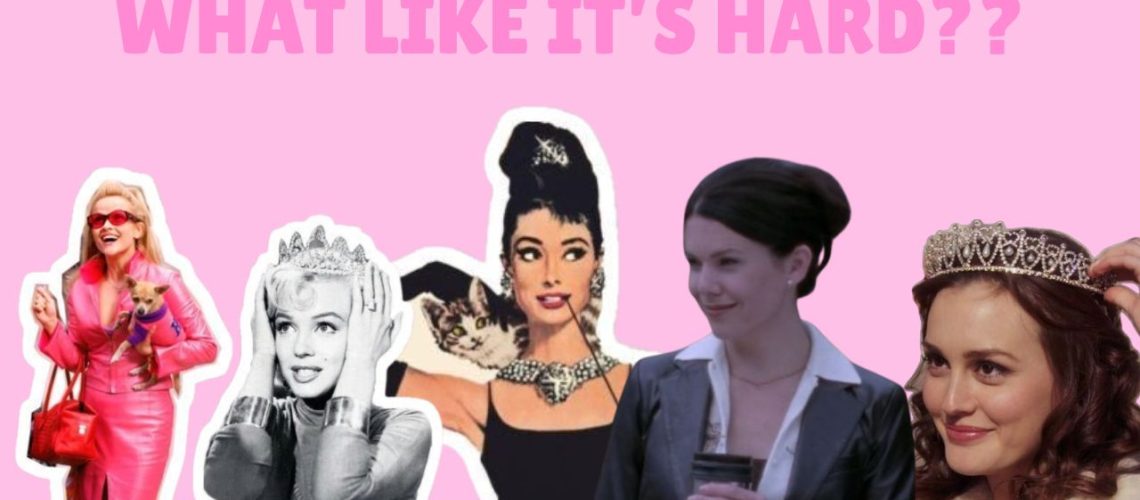
Pop culture is sprinkled – no, strategically sequined – with archetypes who challenge this. Elle Woods (Legally Blonde) cracked Harvard Law in pink stilettos. Rory Gilmore, when she wasn’t being tragic in Season 6, carried around Proust and perfect fits.
But they were often treated as anomalies – the exceptions, not the rule. One-of-a-kind wonders who somehow managed to be smart despite being girly.
What’s radical now is not just celebrating these women, but recognizing that their “girlishness” didn’t dilute their power. It amplified it. Their femininity wasn’t a barrier to their ambition. It was a language – one of their own.
And if we’re being honest, patriarchy doesn’t fear a woman who codes like a man. It fears a woman who codes her own language and refuses to translate.
The Feminist Case for Being Girly
Let’s be clear: choosing to be “girly” in a world that tells you not to is political. Femininity, when reclaimed on our terms, becomes resistance. Think Audre Lorde’s insistence that self-care is political warfare. Think bell hooks writing about love as a radical force. Think about every girl who’s been mocked for liking makeup but runs million-dollar businesses out of her bedroom.
There is power in softness, if we stop mistaking it for weakness. There is rage in beauty, if we stop dismissing it as vanity. And beauty with brains? That’s not a compliment- it’s a cage made to sound like praise.
We are not confused. We are not compensating. We are complex. And we’re not interested in dismantling the master’s house while cosplaying as the master. We want new blueprints. Ones with glitter margins.
In Defense of the “Difficult” Women
I’ve always had a soft spot for the women everyone loves to hate. The “too much” girls. The “attention-seekers.” The ones who are called dramatic, bossy, high-maintenance, fake, shallow, or dangerous – depending on which part of them made men feel small.
Because if men are the ones writing the story, then of course women who take up space, who flirt with power, who cry loudly or walk in like they own the place – will be cast as villains.
I loved the women who were mocked for being ambitious. For being pretty and outspoken. For wearing lipstick and wanting the last word.
They were punished for being seen through the narrowest lens – one shaped by the male gaze and sharpened by internalized misogyny.’Cause anything too emotional, too expressive,too loud, too pink? It didn’t fit the frame.
But I saw them and I learned from them.
Because if the world hates a woman, chances are she knew exactly what she was doing.
So What Now?
We stop apologizing. For the bows in our hair. For the softness in our voice. For the notebooks covered in stickers. For crying in public and quoting Judith Butler. For listening to Taylor Swift and reading Marx.
We take up space – all of it. With our eyeliner sharp and our minds sharper. With lip gloss that doubles as war paint. With rage wrapped in tulle. With glitter that blinds the system.
Because I’m not here to pick between being a girl and being a boss. I am both. And the world better get used to it.
Sincerely ,
— Editor-in-chief, typing in lip gloss and logic
