
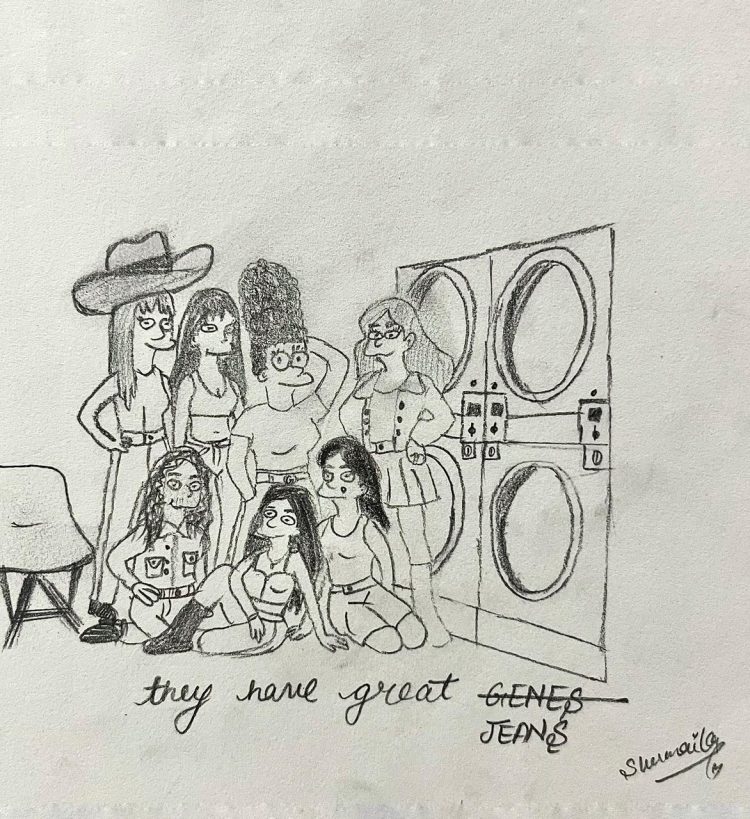
How Sydney Sweeney, American Eagle, and a pair of blue pants unraveled a century of denim politics.
Two blondes, two commercials, two different claims on Americana, and a nation that, as usual, read far more into the second one than the makers ever intended.
Beyoncé, in Levi’s, has been playing a familiar trick on us: she borrows the grammar of the old Launderette ad (Nick Kamen, 1985), keeps the mise en scène (a laundromat, a washer, the stripped down showmanship), and then, because she is Beyoncé, upends the premise. In a wash of Cowboy Carter pageantry she shucks jeans into a drum with diamonds, not detergent, and in doing so reassigns a piece of Americana that was assumed to belong to a white male past into her particular present. The commercial is sleek, staged, and, as all Beyoncé moves are, strategic; it both delights and remodels a brand’s provenance.
Then there is Sydney Sweeney, whose American Eagle campaign arrived like a text message from another era and somehow read, to many people, as a thesis. The ad package is a clotted stew of tones: car commercial fantasy (Sweeney wiping oil off her hands on her backside, a Mustang in the background), mock audition skit (a man off camera asks for her hands and she obliges), and the trente second tableau that would not have seemed out of place in a fever dream about advertising’s worst impulses — Sweeney lying supine while the camera, in what might have been intended as glorification, pans over her body as she zips up her jeans and pronounces, with a conspiratorial smile, “My genes are blue.” The tagline, delivered like a punchline rescued from a bad chemistry lecture, reads: Sydney Sweeney has great jeans.
It began, as these things do now, with a pun. Puns are the polite cousins of the culture war: slight, clever, habitually misread. But “genes” spoken by a blue eyed woman, in ritualized denim, landed differently than the creative team presumably intended. Within hours TikTok and Twitter had transformed the slogan into a text to be read for subtext; critiques, some blistering and some comic, labeled the copy a dog whistle, an echo of eugenic rhetoric, an invitation to a mythology of heredity dressed in cotton. Others insisted this was, at most, a clumsy attempt at levity: bad copy, not bad politics. The schism hardened when Donald J. Trump, whose instinct is to nationalize everything that goes viral, posted a fuelsome endorsement on Truth Social: “Sydney Sweeney… has the HOTTEST ad out there… Being WOKE is for losers, being Republican is what you want to be.” The former president’s applause turned a marketing skirmish into a political moment.
American Eagle, for its part, did what brands do when they are both defended and confused; it declared, flatly, that the campaign “is and always was about the jeans. Her jeans. Her story.” The company’s public facing calm did little to dislodge the conversation; if anything, the outrage proved fertile ground for attention. Sales momentum followed: the collection reportedly sold out, and Wall Street appeared to approve too, with the retailer’s shares seeing an immediate bump as the item sold through. Whether the move will cement longer term brand loyalty or register only as a volatile bloom on social metrics is something analysts will, prudently, argue over.
If American Eagle’s spot was read as a nostalgic nod, wilfully or not, toward a particular palette of beauty standards, Gap’s reaction read more like a corrective memo. Barely days after the Sweeney brouhaha, Gap dropped “Better in Denim,” a high tempo commercial featuring KATSEYE, a multinational girl group, dancing to Kelis’s “Milkshake.” The voiceover spelled it out in friendly, corporate cadence: “Your individuality. Your self expression. Your style. Powerful on your own, even better together.” The message was obvious: denim belongs to a global pluralism, not to the solipsistic reveries of a single star. The clip became a TikTok seed, with in store dance trends and a spike in Kelis streams. In the contest of narratives — one of solitary blondness, the other of chorus line inclusivity — denim had become the battleground.
All of this might read like a disproportionate conversation about snackable advertising if denim were a recent invention. But denim is not simply a fashion; it is a social text. The cloth’s story is a long one: its name probably traces back to serge de Nîmes, a twill from southern France, and in its modern form the riveted work pant was patented in 1873 by Levi Strauss and Jacob Davis. From miners to ranchers to factory hands, denim began its life as a utilitarian garment; its durability made it the clothing of labor. The historian’s shorthand is instructive: the garment that clothed laborers became a symbol of freedom, a rebellious uniform, and, paradoxically, a highly marketable sign.
Those genealogies matter because garments, as scholars remind us, carry the sediment of history. Denim arrived, in the United States, in contexts deeply bound to labor and hierarchy. In the antebellum and Jim Crow eras, rough indigo cloth often signified the working body; it was the garment of field hands and sharecroppers. Yet by the mid 20th century denim had been appropriated as the costume of rebellion: Marlon Brando’s leather and denim biker; James Dean’s bored, beautiful slouch; so that jeans became both a literal uniform of toil and a symbolic uniform of resistance. During the civil rights era activists adopted denim overalls as an emblem of solidarity with the working poor; in places where American blue jeans were banned or smuggled, behind the Iron Curtain for instance, the garments became totems of desire and dissent. These shifts show that a pair of pants can be a small archive: wear patterns denote toil, tears can map journeys, and a cuff can be a class statement.
Which is why a three line joke about heredity can trigger an avalanche of meaning. Words do weightier work when they sit on bodies charged by history. “My genes are blue” becomes a comedy line in one ear and, in another, an invocation of old hierarchies. Critics who read the ad as a racial dog whistle are not conjuring a conspiracy out of thin air; they are listening to a culture that has long taught itself to hear signs in dress. Conversely, defenders who see only political correctness run amok imagine a world where a pun cannot possibly be freighted with legacy. Both are, in their way, right: the ad was both puerile and accidental, and yet it was also a mirror held to a nation that reflexively turns consumer culture into confession and campaign trail alike.
And then came the punditry, which, in the American way, alternately mocked and weaponized the moment. Stephen Colbert scoffed; conservative media fawned; commentators on the left rolled their eyes or made historical connections. Trump’s social media eulogy, part cheerleading and part culture war slogan, amplified a tiny corporate exercise into a political totem. Whatever Sweeney’s own politics are — and she has, at times, been coy about labels — the ad became a vessel for other people’s politics.
The spectacle is both modern and ancient. Fashion, which often likes to tell itself as frivolity, has never been merely surface. From dresses that carried clandestine political messages to uniforms that transform civilians into soldiers, clothing has always performed civic logic. Denim’s long arc — work pant, outlaw costume, sloganized commodity — makes it especially porous. Brands know this. So do politicians. So do consumers. The Sweeney moment exposed the way meaning accrues to cloth: it is not only an object to be bought; it is also a ledger to be read.
One of the slipperiest things in this debate is sincerity. Was the agency’s copywriter malicious, calculating, or merely lazy? Were consumers inventing offense because that is how we now read the world, or were they rightly pointing out that language, image, and commerce can together rehabilitate old prejudices? Perhaps the most Shumailian answer is to allow the paradox: the ad was both inartful and consequential. It was a small failure of taste that bumped into a broader public need to assign stories and identities to things that used to be taken for granted. In that sense, a pair of jeans is never just a pair of jeans.
And there are the secondary, amusing and mildly demented, consequences: the ad sold out; stock tickers danced; fashion folks and pundits made careers parsing every syllable. Gap’s kinetic response (KATSEYE, “Milkshake,” choreographed diversity) turned the skirmish into a marketing dialectic: if one brand wants to trade on singular fantasy, another will sell the plural chorus line. Fans uploaded dances filmed in Gap storefronts. The brand to brand retort had a theater of its own: capitalism doing what capitalism does best, turning controversy into content into commerce.
More than anything, the episode demonstrates how the banal and the political now conspire. Once, politics arrived by searing manifestos and manifest events; now it often arrives as a three second visual, looped and captioned and sent into the public square. “Genes” or “jeans,” the wordplay is less important than the fact that we have made a cultural habit of treating marketing as text rather than mere sales copy. That habit allows us to find, in a fifty second clip, anxieties about race, nostalgia, and power. It is not a particularly grand transformation, but it is the one that marks our era: everything is commentary, everything is performance, everything is a possible seed for outrage, mockery, or commerce.
There is, in the end, a kind of tragicomic symmetry to the whole affair. An actress who sells bathwater and launches lingerie lines and who, in interviews, notes that acting alone cannot pay all the bills is also a cultural cipher. A song from Beyoncé recodes the country in rhinestones; an ad about the fit of jeans provokes talk of heredity and whiteness. The fabric that began as a utility cloth has accumulated so many meanings that it is now a small cathedral where our conflicts are prayed through in hashtags.
If journalism is “the art of making the important interesting,” as someone once said, then modern fashion is the art of asking interesting questions with things we used to regard as insignificant. A hemline, a line of copy, a choice of background music: these are the details that, in our moment, announce who we think we are. A starlet in blue jeans, a brand in a boardroom, an ex president on a social feed — the cast is absurd and, simultaneously, perfectly apt.
So let us not be surprised that a pun about jeans became a debate about genes; that denim returns, again and again, to the center of national self definition. The seams are too full of history; the dye is stubborn; the mythologies stick. Fashion, after all, is a language. And Americans still speak it, loudly, badly, and extremely online.
