
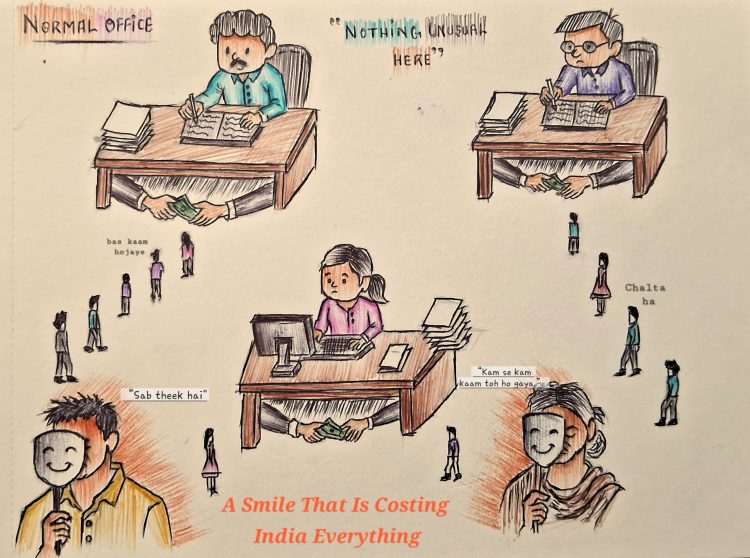
Recently, my exams were over, and I went to my hometown. A road expansion project is currently underway there, and part of my family’s land is being acquired. I was asked to take my aunt to the district headquarters because some paperwork had been missed, and the compensation for the land acquired by the government was still on hold.
When we reached there, a lady handling the paperwork greeted us. She looked just like any one of us. She opened our file, spoke to us for a while, and said that everything was fine. The money would be transferred to my aunt’s account within a few days.
As we were about to leave, she smiled. I still remember that smile clearly—a smile of achievement. Then she said, “Kuch hamara bhi ho jata agar…” and paused for a few seconds.
I looked around at everyone in the office, and to my surprise, everything seemed normal. This was normal.
My aunt asked me to give her some money. I handed over ₹500 with a faint, helpless smile.
Let me make this clear: we paid someone to receive our own money for our own land.
On the way back, I kept asking myself: Who was wrong here? The government employee? Society? Or me?
We all smiled, but for different reasons.
I remember a lekhpal whom people in my village call a “good man.” Do you know why? Not because he is honest or because he does his work properly, but because he takes bribes and still gets the work done. People say, “Paisa lete hain, lekin kaam to kar dete hain.”
This is the state of our society—we have started accepting corruption as normal.
Another incident comes to mind.
Recently, my village was selected for the construction of a library. Everything appeared to go smoothly. The books arrived, along with chairs and other furniture, at the village Panchayat Bhawan. I was genuinely excited and went there to see what kind of books had been purchased.
At first glance, everything looked fine. There were 964 books.
Then I read the official documents.
Those 964 books alone had reportedly been purchased for ₹11 lakh. And I am only talking about the books—forget the furniture and everything else.
My friends and I were shocked by the scale of corruption. As we walked back, we smiled again—but this time, it was a smile of devastation.
After all this, I still believe that we, too, share some responsibility for the condition we are in.
The smiles we wore were part of the problem.
We are not only victims; in moments like these, we also become participants. The real victims are the country and the poor people who could have benefited from the money lost to corruption.
What can we expect if we continue to choose people based on religion, caste, or every other division except their work? Why should we expect them to govern differently?
If I had stood up to that lady and confronted her, and then smiled, that smile would have meant something.
If I had posted the video I made about the library books and demanded accountability, and then smiled, that smile would have been earned.
Until then, I am also part of the problem—just like that government employee, that lekhpal, and everyone else who enables corruption.
In the end, I believe smiling should not be the final response. Standing up against corruption—and then smiling—is what can bring about the change we believe we deserve.
As for the government, I would say this: a government is often an outcome of society, and society is an outcome of our character and behaviour.
So let us first stand up against corruption, so that someday, hopefully, our government will stand just as firmly against it.
