
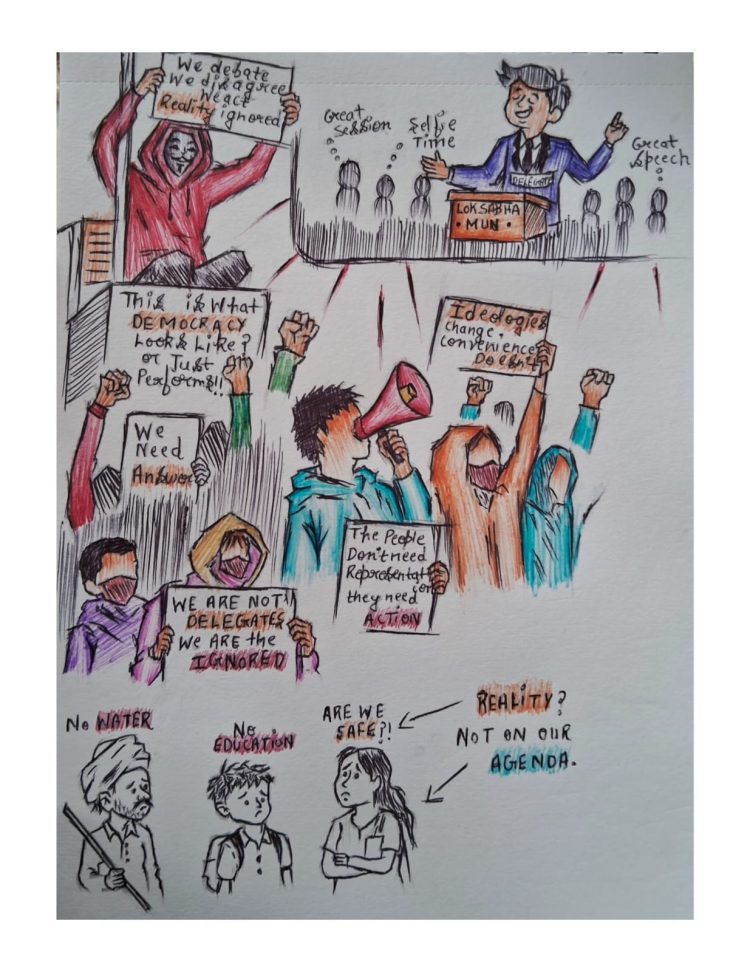
Imagine walking into an MUN as a delegate in the Lok Sabha, dressed in the most aesthetic silk saree or a perfectly styled kurta pajama, clicking Instagram-worthy pictures, offering favours to build alliances and win the “Best Delegate” award, passionately defending ideologies you may not even believe in, and of course, devouring the delicious Samosas and cold drinks served as refreshments.
Now, are we really that different from the politicians who frame policies for us?
My recent MUN experiences gave me a fascinating glimpse into the culture of our legislature. I finally understood why it is called a “Mock” Parliament (pun intended). I absolutely love how every delegate instantly transforms into their assigned character. Suddenly, everyone has strong opinions, powerful speeches, and a commitment to their party’s ideology. Constructive discussions may or may not happen, but a dramatic clash of opinions is almost guaranteed.
Watching it unfold was entertaining. It was chaotic, it was dramatic, and honestly, it was a 10/10 experience. I learnt a lot from those sessions, not just about debates and diplomacy, but also about human behaviour.
However, after returning from those dazzling moments, a small voice of reflection always found its way back to me.
(Yes, imagine the most cinematic cab ride possible, with a Vande Mataram flute version playing softly in the background.)
“Why are you taking this so personally?”
Those words were spoken by the delegate of the ‘XYZ’ party (LOL algebra really did teach me a safe system of nomenclature, if not much else) while responding to the delegate of the ‘ABC’ party, who was speaking about the degrading conditions of our nation.
“Why are you taking it personally?”
That sentence stayed with me.
A day that was supposed to be filled with college memories, laughter, and photographs suddenly transformed into a moment of uncomfortable self-reflection.
“Everyone should,” I had wanted to say.
“You should be ashamed if you are not taking it personally.”
I wanted to yell that into the microphone.
But the placard in front of me reminded me that we belonged to the same alliance. My personal beliefs, my moral responsibility, and my individual voice suddenly became secondary to a label of power and convenience.
Shayad aisa hi hamare netaon ke saath bhi hota hoga.. khud ki pehchaan ko bhool ke voh bas ek sadasya ban jaate honge.
Maybe somewhere, the responsibility towards the nation gets buried under the weight of party identities and political boundaries.
So I stayed silent.
Like many citizens of our country. Apolitical and too busy in their own lives to care.
The session ended with more than 150 photographs, countless laughs, heated arguments, and an unpassed bill.
But honestly, it barely mattered.
Come on,it was just an MUN. It was meant to educate us, challenge us, and provide us with an experience.
It was not the Lok Sabha of our country, the institution responsible for economic development, social progress, and the future of millions.
Yet, I cannot deny how accurately it reflected certain aspects of our legislative culture. Debates drifting away from important issues, critical matters waiting for attention, sessions ending without meaningful outcomes, and politics sometimes overshadowing purpose.
But the people sitting there in our actual Parliament are not participating for a certificate or a “Best Delegate” title.
They are not there for photographs, flirting through MUN chits,personal popularity, or ideological battles that lead nowhere.
They are there to frame real policies, make real decisions, and take India towards progress.
They did not pay a registration fee of ₹1000 to be there.
So whose money is it?
Mine.
Yours.
Ours.
Every rupee spent in a parliamentary session, every resource used for governance, belongs to the people of this country.( Could have bought a whole bundle of Lays instead of wasting that money on a pointless accusational debate)
The money comes from the taxes of a farmer hoping for a better harvest, from the torn purse of a worker waiting for a better future, from families saving every possible penny to provide their children with education and opportunities.
And when that money is wasted, it is not just a financial loss.
It is a loss of someone’s hope. Someone’s dream. Someone’s life.
So, I ask you:
Isn’t it time we start taking it personally?
I also ask myself, how can I not take it personally?
How can I not take it personally when I walked into that MUN hall, dressed like a lawmaker, pretending to represent a nation whose realities I barely had to face for those few hours?
How can I not take it personally when the air I breathe carries an AQI beyond dangerous limits, yet clean air remains a privilege and not a right?
How can I not take it personally when I held a Bisleri bottle of purified water in my hand, casually taking a sip between debates and speeches, while somewhere in Rajasthan, a woman walks miles under the burning sun, carrying heavy gharas on her head, just to bring a few drops of this water home?
That bottle was a convenience for me.
For her, water is a struggle.
How can I not take it personally when a scheme designed to provide her village with clean water loses its way before reaching her doorstep? When the money meant to transform her life is swallowed by corruption and turns into luxury swimming pools inside the homes of the powerful?
How can I not take it personally when I write this article in fluent English, expressing my thoughts freely, you can read this article in english without struggling, while a boy in a village in Haryana cannot even dream of writing these words because the classroom that was supposed to empower hin never received the resources it deserved?
His dreams were not defeated by a lack of talent.
They were defeated by a lack of opportunity.
How can I not take it personally when my parents wait anxiously for my cab to reach its destination-even that MUN venue, when a simple journey outside home comes with fear, emergency calls, and shared locations?
When women in our country still have to calculate their safety before they calculate their dreams? Any case of molestation, abduction or rape just keeps on travelling between files and hands in the police station and court rooms.
How can I not take it personally when I spend hours stuck in traffic, navigating roads filled with potholes that resemble the surface of the moon?
(At this rate, we might not even need a space mission. The next lunar expedition can simply begin from our roads.)
How can I not take it personally when my generation is promised dreams but handed uncertainty?
When my friends prepare for years only to see their futures shaken by paper leaks and then cry?
When young people have degrees in their hands but no guarantee of opportunities waiting for them?
When talent, hard work, and ambition are forced to compete against broken systems?
How can I not take it personally?
Because the woman walking miles for water is not someone else.
The girl waiting for education is not someone else.
The student waiting for a fair chance is not someone else.
They are a part of the same India I belong to.
So maybe taking it personally is not the problem.
Maybe not taking it personally is.
While writing this article, I thought of many titles. Something like “Why Are We Not Taking Things Personally?” or “The Problems With India’s System” would have been more obvious.
Yet, I chose The India I Dream Of.
A title that may seem disconnected from and irrelevant to everything I have written so far.
But it is not.
Any agitation is meant for a positive beginning not a negative shutdown.
This article is not written out of anger. It is written out of hope.
Hope that our story is not over. Hope that the youth of this nation will not accept injustice as our destiny. As long as there are minds that question, hearts that care, and voices that refuse to stay silent, change is still possible.
I dream of an India where education is not a privilege but a promise. Where a girl’s dreams are not limited by her birthplace. Where women walk without fear, where farmers live with dignity, where the youth find opportunities instead of uncertainty.
I dream of an India where progress is not just seen in buildings and numbers, but in the happiness, safety, and dignity of its people.
And no, this is not a political statement.
I am neither a supporter of XYZ or abc party nor an opponent of another. I am a supporter of my nation’s flag. A flag that has made me smile more times than any political speech ever could.
Everytime I salute the Tiranga, a wave of pride, patriotism and belonging hits me.
But patriotism is not just celebrating our achievements. It is also having the courage to acknowledge our failures and the determination to change them.
I grew up listening to the stories of the Mahabharata, especially Draupadi’s cheer haran. It taught me that injustice does not survive only because of those who commit it, but also because of those who choose silence.
As Ramdhari Singh Dinkar ji reminded us through his powerful words, the silent spectators of injustice cannot escape responsibility forever.
“समर शेष है, नहीं पाप का भागी केवल व्याध,
जो तटस्थ है, समय लिखेगा उनके भी अपराध|”
So, maybe it is time.
Time to question.
Time to care.
Time to take things personally.
Because before a problem becomes personal enough to hurt us directly, we must understand that every problem of this nation already belongs to us.
“The India I dream of will not be created by those who wait for change.It will be created by those who choose to become the change.”
Jai Hind.
