
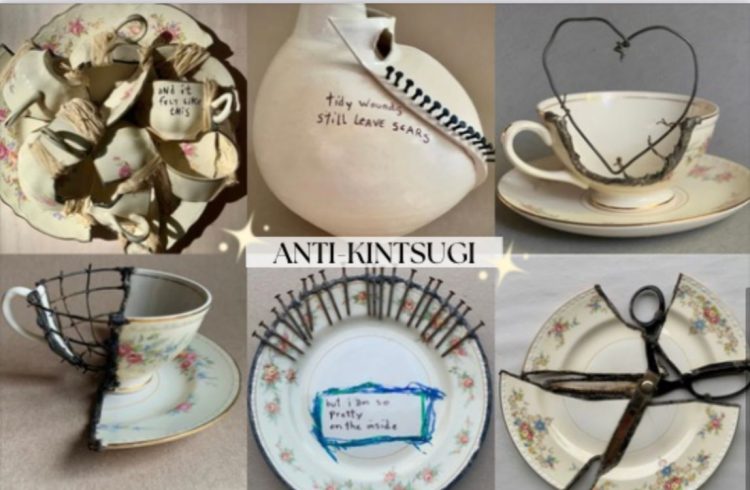
Let’s begin with a broken plate. Not metaphorically (though feel free to go there), but literally: a piece of fine china, fractured, splintered, and now reassembled not with dainty care but with steel bolts, barbed wire, and what looks suspiciously like industrial hardware pilfered from a junk drawer in a basement workshop.
This is the world of Glen Martin Taylor (IG: @glenmartintaylor), a ceramic artist whose work hurls a wrench (sometimes literally) into the delicate mythologies we attach to beauty, repair, and sentiment. If kintsugi, that meditative Japanese art of mending pottery with gold, tells us our cracks are precious, Taylor replies, “Sure. Precious like trauma. And just as painful to live with.”
The Beauty of the Unpretty
Where kintsugi wraps breakage in the soothing glow of redemption, Taylor’s ceramics are practically yelling. They don’t whisper stories of resilience. They scream, “LOOK WHAT HAPPENED TO ME.” Plates are sutured with thread and nails. Teacups are held hostage by thick black wire. A vintage saucer, probably once admired in a Victorian parlor, is now speared through by scissors.
Take, for instance, the plate that reads, “But I am so pretty on the inside” (posted June 18), its rim pierced with a perimeter of nails like a crown of thorns. Or the one declaring, “Tidy wounds still leave scars,” with nails barely holding its fragile form, like a smile that tries too hard.
It’s art that has no time for your soft-focus Instagram epiphanies.
It’s art not for aesthetics but for catharsis.
Fine China, Finer Rage
Taylor’s genius lies in his collision of codes. On one hand, the vocabulary of domestic nostalgia: floral china, doilied patterns, ceramic rabbits. On the other, the violent lexicon of trauma: clamps, duct tape, hammers, severed limbs.
This isn’t just visual dissonance. It’s a conceptual gut-punch.
One piece, a dainty cup split open and stitched with thick wire, practically dares you to pour tea in it. Another features a perfectly nice plate, scorched and scrawled with the phrase, “Now is it.” It’s not clear what that means, but it doesn’t sound reassuring. And maybe that’s the point. Nothing about recovery is.
It’s domesticity as a battlefield.
If Martha Stewart is the propaganda arm of home life, Glen Martin Taylor is the embedded war photographer.
Look What It Took
Let’s put this old fable to bed. The one where trauma is a character-building exercise and pain comes with a diploma in resilience. You’ve heard it. “What doesn’t kill you makes you stronger.” Right. And falling down the stairs makes you a dancer.
In Taylor’s work, there is no graceful redemption. Just visible sutures. Not golden seams but grotesque welds. Plates that say “Art can save your life,” but look like they’ve barely survived the surgery. Or worse, like they’ve done it to themselves.
These pieces don’t end in triumph. They don’t even end in healing. They sit in the middle of the mess, which, to be honest, is where most of us actually live.
You don’t look at a plate bolted together like a medieval torture device and think, “Wow, so brave.” You think, “God, what happened here?” Which is exactly the point.
There’s no gold-dusted kintsugi romance. Just a teacup wired shut like it’s bracing for another explosion.
This isn’t strength. It’s reflex. A kind of psychic muscle memory for disaster. The work twitches. It clenches. You get the sense that if it could speak, it wouldn’t say, “I’m healed.”
It would say, “I didn’t have a choice.”
Taylor’s pieces are not affirmations. They’re conditions.
Not “I made it through,” but “This is what I look like now.”
Strength, if we must call it that, is just another word for surviving badly, a side effect.
Still Art
Taylor’s ceramics are not polite. They are not precious. They do not attempt to hide the fact that damage hurts, that repair can feel like violence, that stitching yourself back together often means reaching for tools you barely know how to hold.
In a culture obsessed with being “whole,” Taylor suggests that wholeness is a myth and a dangerous one.
What his plates offer instead is a kind of ugly grace.Not the fantasy that brokenness makes us beautiful, but the colder, harder idea that brokenness is simply real.
And if you need a little beauty with your truth, you’ll find it. Not in the shimmer of gold leaf, but in the jagged honesty of a plate screwed together like a hostage situation at a vintage store.
Postscript: Handle with Care. Or Don’t.
Art doesn’t always have to inspire. Sometimes it just has to tell the truth.Glen Martin Taylor’s work may not mend your heart, but it’ll show you what it looks like cracked open.
And that, too, is a kind of beauty.
One that doesn’t flinch.
Even if the plate does.