
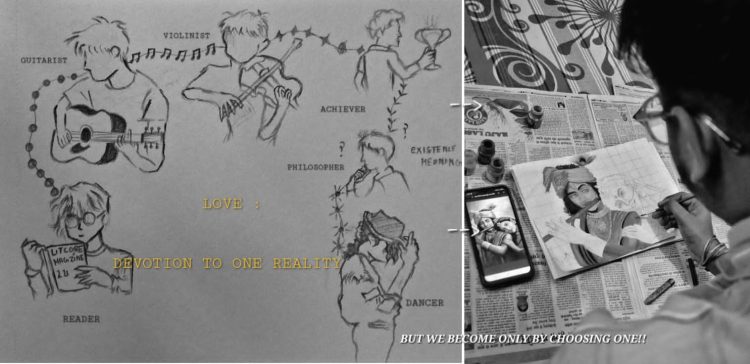
“Find something you love and let it kill you.”
There are certain quotes you do not merely admire. You return to them repeatedly, almost unconsciously, at different stages of your life, and each time they reveal another layer of yourself back to you. For me, this quote by Charles Bukowski has always been one of them.
Whenever life begins to feel like a labyrinth opening into thousands of different paths, some known to me, some still hidden somewhere beyond perception, I find myself returning to it again.
Last night, while watching Everything Everywhere All at Once, especially during Waymond’s final conversation with Evelyn, I think I finally understood what the quote truly means.
At every moment, existence branches into countless possibilities. Every action, every choice, every hesitation could lead toward an entirely different version of yourself. There are thousands of possible “you’s” constantly waiting in the background of existence.
But the tragedy, and perhaps the beauty, of being human is that you cannot become all of them.
You have to choose.
And choosing one possibility of yourself means abandoning countless others.
Not literally, of course, but existentially.
If I choose to become a guitarist, I sacrifice the possibility of becoming a violinist. Perhaps I may have become greater as a violinist. Perhaps the world would have rewarded me more for it. Perhaps I would have become more admired, more successful, more extraordinary through that path.
But if my love belongs to the guitar, then that love itself becomes enough.
Enough to sacrifice all those alternate possibilities of myself.
And I think this is what Bukowski meant.
People often interpret the quote as romantic self-destruction, obsession, chaos, and artistic ruin. But perhaps it is actually about devotion. About allowing one thing to become so meaningful that you willingly let it consume all your other unlived selves.
Because every real choice is, in some sense, a funeral.
This is why The Bell Jar’s fig tree analogy feels so devastatingly true.
Sylvia Plath imagines life as a fig tree where every fig represents a different future. One fig contains love, another art, another intellect, another freedom, another version of herself entirely. But while she hesitates beneath the tree, unable to choose because choosing one fig means losing all the others, the figs slowly begin to rot.
That image captures something terrifying about existence.
The tragedy is not necessarily choosing wrongly.
The tragedy is refusing to choose because you cannot bear the death of your other possibilities.
Modern life intensifies this anxiety infinitely. We are constantly surrounded by evidence of alternate lives. Every person online seems to embody some road we did not take. Every talent we encounter awakens another dormant version of ourselves.
You are no longer simply living your life.
You are constantly witnessing unlived versions of it.
Which is why Everything Everywhere All at Once feels emotionally overwhelming. Evelyn is not suffering because her life is objectively meaningless. In fact, she was barely conscious of her dissatisfaction until she became aware of thousands of alternate versions of herself.
A life alone cannot feel insufficient until it is compared against other possible lives.
And once consciousness becomes aware of infinite possibilities, ordinary existence begins to feel unbearably small.
Then comes Waymond.
Soft, ordinary, tender Waymond.
Waymond, who in another story might easily be dismissed as weak, mediocre, or unsuccessful, understands something Evelyn does not:
A meaningful life is not built by maximizing possibilities.
It is built by choosing one reality lovingly enough that it becomes sacred.
He is not trying to transcend existence. He is not trying to become the “best possible” version of himself across all universes. He simply chooses this life, this love, this reality fully.
And perhaps that is where love truly begins.
Not in possessing every possibility, but in consciously sacrificing them.
This is also what brings me back to Jean-Paul Sartre and his belief that existence precedes essence. Human beings are not born carrying some fixed meaning waiting to be discovered. We become ourselves through choice. Through commitment. Through repeated acts of devotion.
But if existence is built through choice, then choice itself cannot arise merely out of calculation.
Because if you remain calculative, another path will always appear better. More rational. More admired. More successful. Somewhere, there will always exist another version of yourself who “won” more beautifully.
So what finally allows a human being to choose?
I think the answer is love.
Love is what allows you to stop negotiating endlessly with possibility.
Love says:
Even if another road would have given me more, this is still the mountain I want to climb.
And climbing a mountain out of love is entirely different from climbing it for the outcome.
.If you climb only for the summit, suffering becomes unbearable. Every failure humiliates you. Every alternate path begins to haunt you.
But when love itself becomes sufficient, outcomes lose their tyranny.
The mountain may destroy you.
You may never reach the top.
You may even discover that another path would have made you greater.
And still, something inside you says yes.
That yes is devotion.
And perhaps this is the deepest paradox of being human:
We suffer because we can imagine infinite lives for ourselves.
But we become real only by choosing one.
