
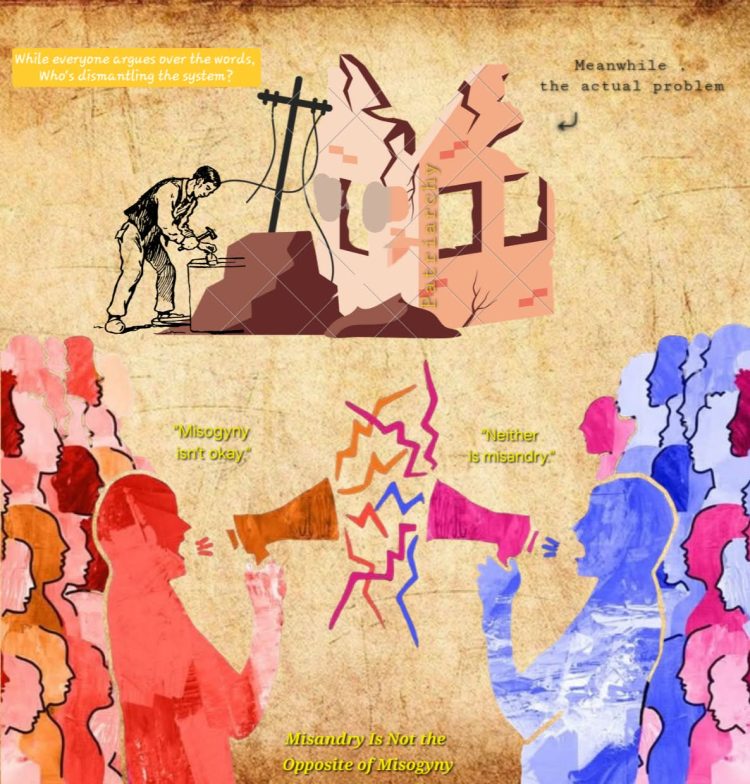
I don’t think misogyny and misandry are opposites.
I think we make that comparison because the words look like opposites. Misogyny—the hatred or contempt for women. Misandry—the hatred or contempt for men. Put them beside each other and the equation seems almost too neat: if one is wrong, surely the other must be equally wrong. Case closed.
Except society is rarely that symmetrical.
Misogyny did not begin as a woman’s reaction to something men had done to her. It has existed for centuries within institutions, traditions and social structures that have treated women as subordinate. It has dictated what women could own, whom they could marry, whether they could vote, work, study, inherit, speak, or make decisions about their own bodies. It has not merely existed as an attitude; it has been woven into systems of power.
And that distinction matters.
Misandry absolutely exists. Women can hate men. Women can stereotype men, dehumanise them and treat them unfairly. I don’t think feminism should pretend otherwise, nor do I think oppression gives people a moral licence to become oppressive themselves.
But I also don’t think we can discuss misandry as though it materialises from nowhere.
Sometimes, what looks like hatred is accumulated exhaustion. Sometimes it is anger after being told to be careful while the person causing the danger faces no such instruction. Sometimes it is the product of repeatedly encountering the same kind of violence until an individual experience begins to feel like a pattern.
That does not make the generalisation fair.
But it makes the generalisation understandable.
And understanding something is not the same as excusing it.
This is the part of the conversation that makes people uncomfortable. We are accustomed to discussing prejudice as though every expression exists independently of history. But resentment has an origin. If misogyny is a condition that women have lived under for generations, it is hardly surprising that anger towards men can emerge from it.
So yes, misandry is wrong.
But I resist the argument that “misandry is just as bad as misogyny” when “just as bad” quietly becomes “socially identical.” Two prejudices can be morally wrong without being historically, structurally, or socially equivalent.
A woman saying “I hate men” and a society systematically teaching women that their lives, bodies and choices are worth less are not the same phenomenon simply because both contain hostility towards a gender.
And perhaps feminism should be brave enough to hold two truths at once: men can be hurt by gender prejudice, and women can be oppressed by gendered structures.
We don’t have to erase one experience to acknowledge the other.
More importantly, feminism should not become a project of reversing the hierarchy. If patriarchy places men above women, the answer cannot be to construct another hierarchy and call it progress. The point is to dismantle the architecture altogether.
Because I don’t want a world where women get to hate men without consequence.
I want a world where women have so little reason to hate men that the sentence itself begins to sound absurd.
Misandry may be born from misogyny. But it does not have to inherit its methods.
And perhaps that is where feminism should draw the line—not between men and women, but between understanding someone’s anger and surrendering to it.
