
Lucknow has always been a lineage of poets, artists and writers. A city that breathes in adab, arz, and andaaz-e-shaan; a city that has turned language into an art of living. Urdu, often called the language of love, finds a particularly intimate home here. Perhaps that is why Lucknow has always known how to admire flowers—even those that have grown in someone else’s garden.
I was introduced to one such flower on an ordinary evening at a literary reading circle in Lucknow.
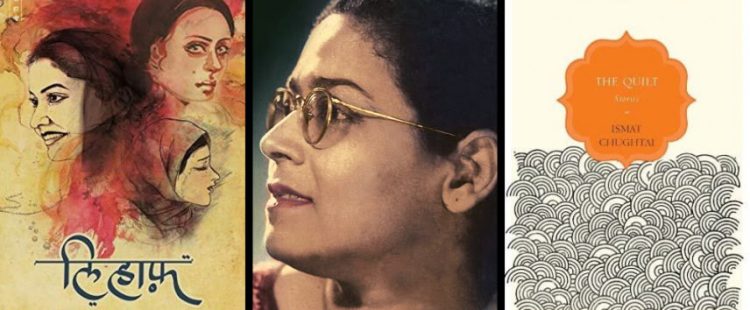
Ismat Chughtai.
Until that evening, as a young Gen Z reader, I had never read her. I barely knew her name. Someone introduced her as a “fierce Urdu writer.”
That adjective felt oddly misplaced.
Fierce?
Could one be fierce in Urdu?
I had grown up imagining Urdu through its familiar vocabulary of romance and refinement—mohabbat, ishq, khwab, shayari. It was the language of longing, of lovers and poets, of beautifully constructed sentences and beautifully concealed emotions.
And then there was Ismat Chughtai.
So, I went home to meet this woman who—I was told—wrote fiercely.
“The pen is my livelihood and my friend, my confidante, a walking, talking friend in my hours of loneliness. Whenever I want, I can send for anyone via the pen’s flying carpet, and when these people arrive, I can say anything, make them cry, laugh, or reduce them to ashes with my harsh words.”
Born in 1915, Ismat Chughtai emerged in the extraordinary literary atmosphere of twentieth-century Urdu literature, alongside writers such as Saadat Hasan Manto, Rajinder Singh Bedi and Krishan Chander, but her rebellion was particularly intimate. She did not need battlefields or revolutions to find politics. She found them in bedrooms, kitchens, courtyards, schools and marriages. She found them in the lives of women whose inner worlds were routinely considered too ordinary, too shameful or too private to become literature.
Ismat wrote about women as though they were complete human beings.
Not simply as daughters, wives, mothers or symbols of virtue, but as people with boredom, beauty, terror, jealousy, anger, curiosity, loneliness, ambition and desire. Her women could be messy. They could be contradictory. They could be sexual. They could be cruel. They could want things that respectable society had never taught them to name.
And she refused to make them convenient.
To know her beyond the controversies, through her writings and memoirs, I have come to know her as a woman, a writer, and a revolutionary.
Her most famous story, Lihaf, is perhaps the most striking example of this refusal. The quilt in the story becomes almost a metaphor for everything respectable society prefers to keep covered.
But Ismat lifts the corner.
She makes you look at what is underneath.
She gives it a name, a voice, a form—a scaffolding upon which subsequent legacies could be built.
And there is something particularly powerful about the fact that she did this in Urdu.
Once you encounter Urdu through her voice, calling Urdu merely the “language of love” begins to feel insufficient. Urdu can be tender, certainly. But it can also be sarcastic, obscene, uncomfortable, political and ferocious.
There is humour, there is banter, there is a texture of humanness that society often tries to conceal beneath the neat coverings of masculine and feminine, respectable and shameful, permissible and forbidden.
Ismat expanded what was allowed in Urdu.
And she expanded what women were allowed to contain within it.
Her cultural significance, therefore, extends far beyond the stories she wrote. Ismat belonged to a generation of writers who challenged the social structures of their time, but her questions have travelled much further than her century. We are still arguing about women’s sexuality. We are still policing women’s bodies. We are still deciding which desires are respectable and which are shameful. We are still more comfortable with women being desirable than desiring.
As a young woman, reading Ismat never feels historical, or like encountering merely a literary signature from another century.
She feels contemporary.
I am also drawn to her because I recognise something of the young woman I want to become in the woman she already was: irreverent without apology, curious without permission, unwilling to make herself smaller simply because the room would be more comfortable that way.
She tells me that words can be beautiful without being obedient.
“My father realised his daughter was a terror, and that there wasn’t a thing he could do about it.”
Perhaps there is something to be said for daughters who evoke terror rather than beauty.
For daughters who refuse to be flowers merely because the world knows how to admire them.
For daughters who learn to lift the quilt. And look.
