
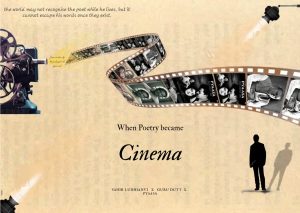
There are films that tell stories. And then there are films that breathe poetry. Pyaasa (1957) is the second kind. Directed by Guru Dutt, it is the story of a poet the world refuses to recognise, and every word in the film, every song, every whispered recitation, carries the weight of that refusal. The man behind those words was Sahir Ludhianvi, a poet before he was ever a lyricist, and in Pyaasa, that distinction disappears entirely. The film doesn’t just have Sahir’s poetry in it. It is Sahir’s poetry.
The film opens its heart gently with Hum Aapki Aankhon Mein. On the surface it is a love song, two voices, a quiet room, and a moment of closeness. Mohammed Rafi and Geeta Dutt sing it with such effortless intimacy that you forget you are watching a film. But Sahir never writes just a love song. Underneath the tenderness is something more fragile, the feeling of someone who has been lonely so long that even this moment of being seen feels almost unreal. That is what Sahir does with romance. He doesn’t celebrate it. He holds it carefully, like something that might not last.
And then, almost without warning, Sahir surprises you. Sar Jo Tera Chakraye is playful, warm, and full of a light that the rest of the film rarely allows itself. It is the song of a street masseur, comic and easy, and Mohammed Rafi delivers it with a looseness and joy that shows just how vast his range truly was. It shows a side of Sahir that is easy to forget, that the man who could write devastating social commentary, could also write something that makes you smile without any effort at all. In Pyaasa, even the lightest moment is perfectly placed. The laughter lands because everything around it is so heavy.
But it is Yeh Duniya Agar Mil Bhi Jaaye where Sahir’s pen becomes something closer to a weapon. This is not a song. It is an indictment. A world built on greed, on false pride, on the bones of the powerless, Sahir looks at all of it and says, quietly but without flinching, that even if this world were handed to him, he would not want it. Mohammed Rafi sings it with a restraint that makes it more devastating than any amount of rage could. And Guru Dutt on screen, hollow-eyed and still, makes you feel every word land. It is one of the most politically honest pieces of writing Indian cinema has ever held.
Pyaasa is perhaps the only film where the poetry doesn’t stop when the songs do. In two spoken recitations, Tang Aa Chuke Hain and Gham Is Kadar Badhe, Sahir’s words become the character’s breath itself. In Tang Aa Chuke Hain, Vijay speaks of a man worn down by life, exhausted not by one great tragedy but by the endless, grinding weight of simply existing. And in Gham Is Kadar Badhe, grief has crossed the point of expression, he drinks not out of pleasure but because the heart has nowhere else to go. These are not songs. They are confessions. And Guru Dutt recites them with an aching devastation that makes you wonder where Vijay ends and Guru Dutt himself begins.
And then there is Jaane Wo Kaise Log The. Of everything in Pyaasa, every song, every recitation, every frame, this is the one that stays longest. Hemant Kumar’s voice carries it like something being remembered rather than sung, and Sahir’s words match that feeling exactly. It is a question, not a statement, what kind of people were they, those who received love in return for love? The question is asked without bitterness, without anger. Just a quiet, aching wonder at a world that the poet has never been allowed to enter. In two minutes, Sahir and Hemant Kumar together create something that most artists spend their entire careers reaching for.
Pyaasa is many things, a film, a tragedy, a protest. But above everything, it is proof of what happens when a poet is given a canvas large enough for his pain. Sahir Ludhianvi didn’t write songs for Pyaasa. He wrote himself into it, his loneliness, his anger, his tenderness, his exhaustion. And Guru Dutt, who understood that pain perhaps better than anyone, gave those words a home. Decades later, the film remains. The words remain. And that is exactly what Sahir always knew, that the world may not recognise the poet while he lives, but it cannot escape his words once they exist.
