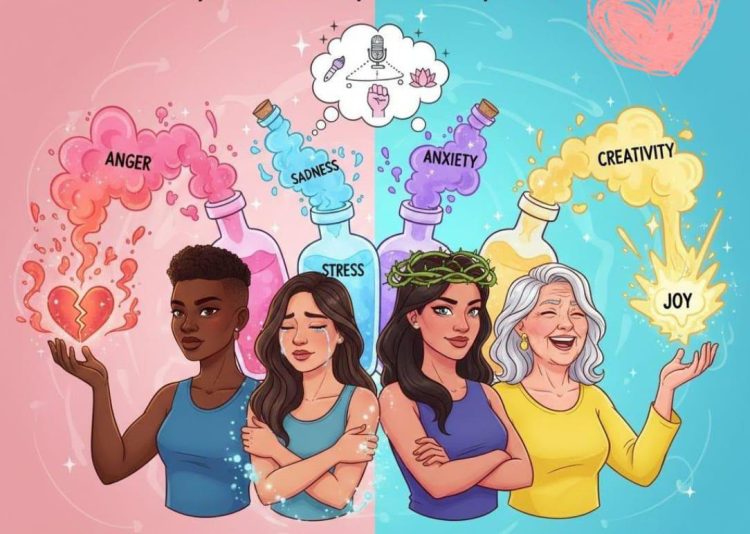
In the lecture halls of Canning College and along the corridors of the Old Campus, we are often taught that the “civilized” mind is a quiet one. Tell a woman to “Calm Down,” and she will hit you back with, “Who are you to tell me what I’m supposed to feel?”
For the women of Lucknow University, these two words aren’t just an instruction; they are a societal mandate, a demand to filter the very core of who we are. Amidst the pressure of exams, the weight of tradition, and the drive for professionalism, we have internalized the lie that deep feeling is a fatal weakness. We are taught that our anger is unprofessional, our sadness is self-indulgent, and our passion is “too much.”
Emotional women are often labeled as “irrational,” “hysterical,” or “weak”. Labels used to delegitimize our authority in seminars and public life. But at LU, a place built on the pursuit of truth, we must recognize that emotion is simply information. Deep feeling is not a barrier to logic; it is a parallel stream of high-quality data.
The campus of Lucknow University can often feel like a pressure cooker, where the weight of expectations is heavy. We are told to ‘toughen up’ to survive competitive exams and societal scrutiny, but this forced silence only leads to internal burnout. We must realize that our deep feelings are not a distraction from our studies; they are the very engine of our survival and the key to our academic longevity.
Furthermore, our Righteous Anger is our moral compass. From the historic student movements in Lucknow to the fight against modern campus harassment, our progress has never been fueled by cold logistics. It has been fueled by the spirit’s refusal to accept the unacceptable.
The “gut feeling” is not random; it’s the subconscious mind rapidly processing complex data: micro-expressions, subtle shifts in tone, context, etc. Women who trust their emotions are leveraging this intuitive intelligence, leading to faster, more nuanced decision-making than purely analytical approaches.
Feeling “everything deeply” is a healthy, natural way to process trauma, grief, and stress. When women are told to “toughen up,” they suppress these feelings, leading to burnout and health issues. Deep feeling is the engine of emotional healing.
Deep feeling is not just an internal process; it is the driving force behind meaningful social change and collective progress. Take Righteous Anger, for example: our reactions to inequality, harassment, and injustice are not simply expressions of “bitchiness” or over-sensitivity; rather, they serve as a moral compass, reflecting our spirit’s refusal to accept the unacceptable. Every major feminist movement, from the fight for suffrage to the significant impact of #MeToo, has been fueled not by cold logistics but by this powerful, righteous emotion.
Moreover, our ability to deeply feel plays a crucial role in what I call the Resilience Cycle. When we allow ourselves to fully process feelings of sadness, grief, and despair, we pave the way for true healing. On the other hand, suppression, the act of filtering our emotions, only leads to burnout and collapse. Deep feeling, therefore, is the quickest path to lasting resilience.
Finally, through Collective Empathy, women often carry the emotional burden for their communities. This profound capacity to feel the pain of others is precisely what fosters mutual support, builds solidarity, and inspires the collective action necessary to transform the world.
Imagine a vast ocean: deep, constantly moving, and powerful enough to shape the land.
Now, consider the notion that the very movement of this ocean may be perceived as a sign of instability. This reflects a broader narrative concerning women in society. We embody deep reservoirs of emotion, capable of profound compassion, intense frustration, and genuine joy. However, societal conditioning often leads us to fear our own emotional depths, to smooth our surfaces, and to present ourselves as ‘manageable.’ As a result, we might find ourselves simplifying our experiences to fit a more conventional mold.
It is essential that we recognize and celebrate the full spectrum of our emotions. This should not be viewed as a weakness; rather, it demonstrates a higher level of emotional awareness and intelligence. It is time for us to embrace and take pride in what we truly embody.
Let us stand down from the exhausting task of being manageable. Let us abandon the filter we were handed, the one that required us to shrink our voices and contain our mighty inner lives.
Know this – Your depth is your dimension. Your tears are the salt of wisdom, your passion is the fire of truth, and your anger is the shockwave of change. You were never meant to be a polite, still pond; you are the vast, untamable ocean.
It takes courage to let those tides surge. It takes pride to own that power.
To my fellow women at the University of Lucknow: reject the guilt of being “too much.” This feeling is a deliberate, conditioned response aimed at keeping us compliant. Our mission is to embrace our emotional capacity as a source of pride, as proof of our genuine connection and unwavering moral courage.
Stop apologizing for your volume, your passion, or your necessary tears. The final, revolutionary act is simply this: to allow our hearts to be the powerful, unfiltered organs they were truly meant to be. You were never meant to be a still pond; you are the vast, untamable ocean.
Go forth and feel with the ferocity you were born with.
Let Lucknow witness the full, magnificent, and unapologetic force of who you are.