
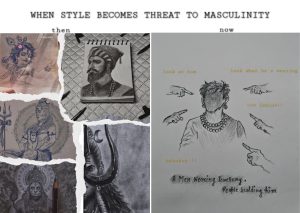
Fashion has never been about clothes, as clothes have always been a reflection of persons’ identity, status, profession, culture and personality throughout history. Fashion is a language of self-expression that has ranged from the royal attire of kings and emperors to the accessories of warriors. But in 21st century India there is a strange contradiction: fashion is celebrated but men who actively participate in it are often judged.
However, fashion has never been a stranger to Indian men historically. Ancient kings used jewels, embroidered clothes, turbans, and accessories to decorate themselves. Rajput rulers wore elaborate jewellery, Mughal emperors wore luxurious fabrics, even soldiers paid attention to their appearance. Looking good meant dignity and confidence, not a threat to masculinity.
But for today’s men, if a man pays attention to their appearance and wears clothes for his confidence and dignity he is often judged by so-called ‘alpha males’.
Somewhere along the way, Indian society defined what a “real man” should look like in a narrow way. A man with a plain bracelet can be questioned today. He was open to mockery for carrying a tote bag instead of stuffing everything into his pockets. A man interested in skincare is often labelled vain. A fashionable man sometimes is referred to as “too feminine” before anyone even knows him. It’s hard to miss the irony.
Society tells men to be successful, confident and attractive, and then ridicules them for the effort it takes to look that way.
We applaud the fashion choices of well dressed celebrities, athletes and influencers, yet many ordinary men are chastised for wearing similar outfits. This contradiction tells us less about fashion and more about our insecurities about masculinity.
One of the biggest reasons behind this mindset is the belief that masculinity and aesthetics can’t coexist. Masculinity still means, for a lot of people, images of ruggedness, not caring and not showing your emotions. Within this framework, being concerned about clothes, grooming or personal style is feminine. But this assumption contradicts history and common sense. You don’t gauge confidence by how little work someone does to look good. If anything, I would say it shows more confidence to be able to say what you want without being judged. This is particularly visible mostly in urban areas. Fashion is a tricky word for young men trying their hand at it.
On the other hand, you have those who celebrate self-expression and individuality.
As others believe, fashion should be restricted to gender boundaries. The result is a constant tug of war between open mindedness and social conformity.
Perhaps one of the most absurd examples of criticism is that about men carrying bags. Women with handbags are normal but the moment men walk around with cross body bags, tote bags or designer accessories, questions of masculinity are raised. The object itself is practical as it holds essentials more comfortably than overloaded pockets. But many critics are not concerned with utility but with antiquated gender associations.
Similarly, fashion-forward men are often the butt of jokes and stereotypes. Bright colours, accessories, layered outfits or alternative styling are often met with suspicion. Ironically, many of the people who criticise these choices are the same ones who idolise international celebrities, athletes and actors who wear fashion without reservation. This double standard demonstrates how social conditioning often dictates opinions more than logic.
It’s not about forcing everybody to become fashion enthusiasts. If people want to dress down they should be able to. The problem is when people start questioning someone’s masculinity, character or identity based on their personal decisions.
Fashion should remain a matter of choice, not a test of gender roles.
Real confidence isn’t about fitting into society’s narrow definitions of you, it’s about being comfortable with yourself.
The biggest irony that disproves a lot of modern stereotypes could be Indian history itself. Sometimes the same civilisation that used to dress its kings in jewels and its warriors in elegance will look suspiciously at a well-dressed man. So the question is not about fashion. The problem is in the way we see it.
But as India modernises, it also needs to rethink its notion of masculinity. Masculinity need not mean the rejection of beauty. Fashion doesn’t need to be accompanied by a need to defend your identity. There’s nothing wrong with a man walking around with a bag, wearing accessories or caring about his appearance. It’s not about masculinity, it’s about freedom of expression. Fashion has always had a voice.
What is most frustrating about this debate is that most Indian men who splurge thousands on motorcycles, watches, or health club memberships do not raise any suspicions regarding their masculinity. But as soon as the same men begin taking an interest in fashion, skincare, accessories and aesthetics, there is suddenly a problem.
The truth is that it is not fashion; it is society’s apprehension at seeing men break out their conventional mold. When masculinity is so fragile as to consider the threat posed by something like a handbag, a ring, or a fashionable outfit, it stops being about self-assurance and turns into insecurity wrapped up in culture.
Additionally, fashion has always progressed through the process of breaking societal norms. Many things that we currently consider masculine have been ridiculed and even condemned at different times. Long hair, earrings, bright clothes and even types of cloth have changed genders during periods of history. Objects, colors, and even clothes have no gender assigned to them; they are what they are; a bag is a bag, jewellery is just an accessory, and clothes are only fabrics sewn in certain shapes. The meaning of these items is determined by society or can be transformed by society. For India to be a modern nation, it should learn how to differentiate between cultural heritage and prejudices.
This is because India currently stands at a unique crossroads, where the country wishes to become a world power, celebrate individualism, promote innovation, but often finds itself scared of people who want to express themselves in a different way. In the end, fashion trends in the future are not going to be about mimicking western trends or forgetting one’s traditions, but rather granting oneself the right to choose what works for oneself without ridicule.
The issue is not whether men should be able to carry bags, adorn themselves with jewellery or wear colored outfits. The issue here is why society feels justified to criticize such behavior to begin with. True manhood does not require validation, and true confidence does not rely upon conformity. Therefore, real freedom only comes from having the possibility to do things your own way without being judged for the same.